

Between 2025 to 2026, the Department of Migrant Workers (DMW) initiated a gradual transition from the traditional paper-based Overseas Employment Certificate (OEC) to the modern digital OFW Pass or OFW Travel Pass. The new system is integrated with the unified government application, eGovPH, to simplify the departure procedures of Filipino migrant workers. To cope up with the modernization of government systems, steps are being taken by the department to ensure a smoother bureaucratic process.
 Copy link


Narito ang mga winning combination para sa 4D Lotto, Mega Lotto 6/45 at Grand Lotto 6/55 para sa araw ng Miyerkoles, Disyembre 17, 2025, base sa 9 p.m. draw ng Philippine Charity Sweepstakes Office (PCSO).
A new era of digital migration and travel
The OFW Pass serves as the digital equivalent of the OEC. It is officially utilized as an exit clearance, a definitive proof of legal status and a basis for exemption from the travel tax and terminal fee at Philippine airports. However, it was observed that the system still operates on a parallel basis with the traditional OEC in 2026. A portion of airlines and immigration officers sometimes continue to request the physical OEC, most especially if there are changes to the employer or contract. If such discrepancies occur, an immediate verification of records would be mandated by the authorities.
Step-by-step guide to generating the digital document
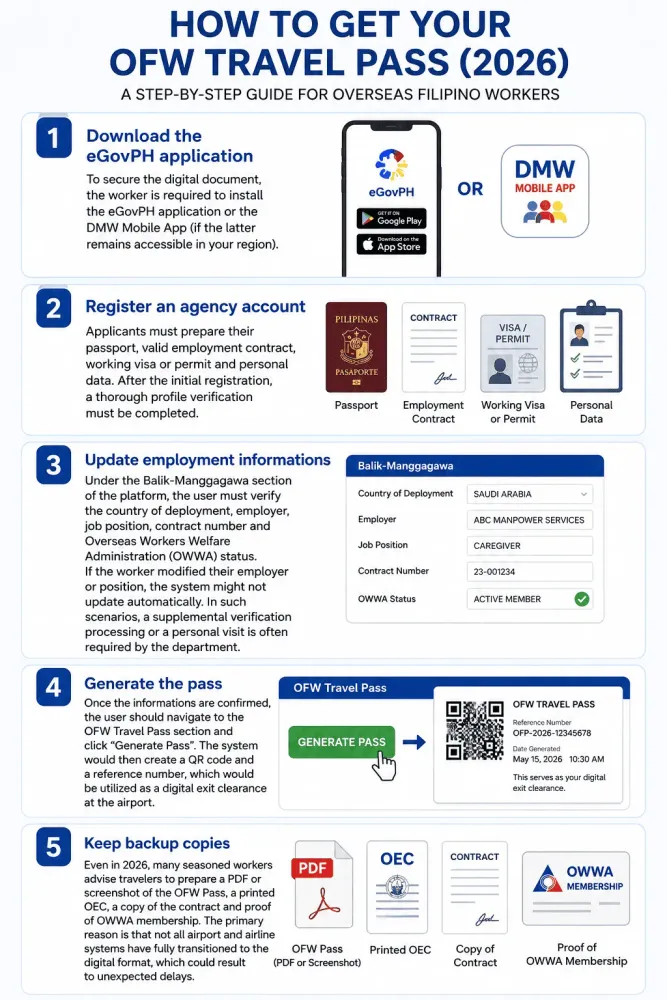
1. Download the eGovPH application
To secure the digital document, the worker is required to install the eGovPH application or the DMW Mobile App (if the latter remains accessible in your region).
2. Register an agency account
Applicants must prepare their passport, valid employment contract, working visa or permit and personal data. After the initial registration, a thorough profile verification must be completed.
3. Update employment informations
Under the Balik-Manggagawa section of the platform, the user must verify the country of deployment, employer, job position, contract number and Overseas Workers Welfare Administration (OWWA) status. If the worker modified their employer or position, the system might not update automatically. In such scenarios, a supplemental verification processing or a personal visit is often required by the department.
4. Generate the pass
Once the informations are confirmed, the user should navigate to the OFW Travel Pass section and click "Generate Pass". The system would then create a QR code and a reference number, which would be utilized as a digital exit clearance at the airport.
5. Keep backup copies
Even in 2026, many seasoned workers advise travelers to prepare a PDF or screenshot of the OFW Pass, a printed OEC, a copy of the contract and proof of OWWA membership. The primary reason is that not all airport and airline systems have fully transitioned to the digital format, which could result to unexpected delays.
Vital exemptions and reminders for workers
The department announced Tuesday that the OFW Pass would have a limited validity, often indicated up to 90 days in several advisories, and could be updated or voided if the contract changes. An automatic transition is most accessible for Balik-Manggagawa or returning workers heading to the exact same employer, identical position and same host country. If a change of employer happened, further procedures are mandated, e.g., a new contract verification, an appointment at the agency, a profile update and the acquisition of a new OEC. When proceeding through immigration checkpoints in 2026, travelers are advised to present their passport, working visa or permit, digital OFW Pass, paper OEC, employment contract and OWWA proof. Despite the official shift, it was reported that some immigration personnel and airline staff still ask for the OEC.