


As overseas Filipino workers (OFWs) look for the most efficient channels to send hard-earned money to families in the province, a shifting digital financial landscape has forced a tight race between electronic wallets and traditional banking institutions.

 Copy link


Narito ang mga winning combination para sa 4D Lotto, Mega Lotto 6/45 at Grand Lotto 6/55 para sa araw ng Miyerkoles, Disyembre 17, 2025, base sa 9 p.m. draw ng Philippine Charity Sweepstakes Office (PCSO).
The Bangko Sentral ng Pilipinas (central bank) has continuously monitored these financial channels to ensure that the influx of foreign exchange does not result to excessive consumer exploitation. Financial analysts noted Monday that the choice between using Mynt’s GCash, Maya Philippines Inc. or traditional time deposits depends entirely on whether the beneficiary prioritizes immediate liquidity or long-term interest earnings.
GCash dominates fast liquidity
For millions of families who need immediate access to cash, GCash remains the undisputed market leader. According to data provided by the financial platform, receiving international remittances is frequently free of charge.
The digital wallet has secured a strategic tie-up with various global remittance applications, allowing users to execute a Payoneer cash-in without any fee, while a PayPal cash-in attracts an estimated 1% charge. To expand its global footprint, direct international transfers are now supported across sixteen countries.
In an effort to alleviate the financial burden of migrant laborers, the platform temporarily waived transaction fees for remittances originating from the Middle East. Independent assessments from online user forums indicated that funds sent via Remitly or TaptapSend would arrive within 7min to 15min.
However, some consumers observed that these zero-fee promotions are occasionally compensated by a less favorable exchange rate. Commenting on the trend, a sectoral solon noted that while digital platforms help families cope up with rising inflation, transparency in foreign exchange conversions must remain a priority for the Department of Finance.
Maya capitalizes on high-yield savings
While its competitor wins the race for speed, Maya operates as a more lucrative vehicle for storing funds after the initial transfer.
The digital bank offered an attractive 6% annual interest rate on its time deposits, with special promotional campaigns driving the effective yield up to 8% through specific consumer spending milestones.
Nevertheless, navigating this platform requires a calculated approach, as a partner cash-in can cost up to 2% to 3% in processing fees. Furthermore, international foreign exchange fees hover around 1.75%, and the platform possesses weaker integration with global remittance services.
Consequently, an emerging strategy among practical consumers involves a multi-step process, i.e., receiving the initial funds through GCash, transferring the balance to Maya, and keeping the capital secured in a high-yield account to accumulate interest.
Traditional banks maintain institutional stability
For large sums requiring absolute security, traditional commercial banks remain the preferred sanctuary, even if they lack the agility of fintech alternatives.
Traditional banking institutions offer between 3.5% to 5.5% annual interest on time deposits. While conventional banks provide unparalleled institutional stability, they process international wire transfers at a significantly slower pace.
For regular monthly remittances, traditional accounts are often less economical due to heavy SWIFT fees, disadvantageous exchange rates and extended processing periods.
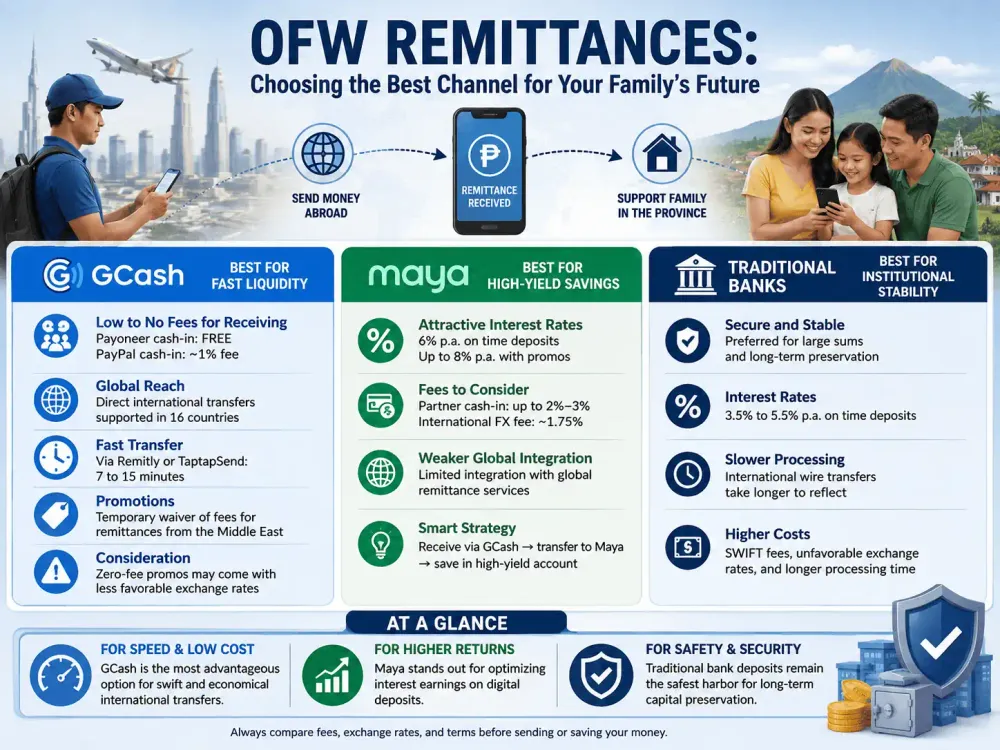
A summary of the current financial ecosystem suggests that for swift and economical international transfers, GCash remains the most advantageous option. Conversely, for optimizing interest earnings on digital deposits, Maya stands out, while traditional bank deposits remain the safest harbor for long-term capital preservation.