

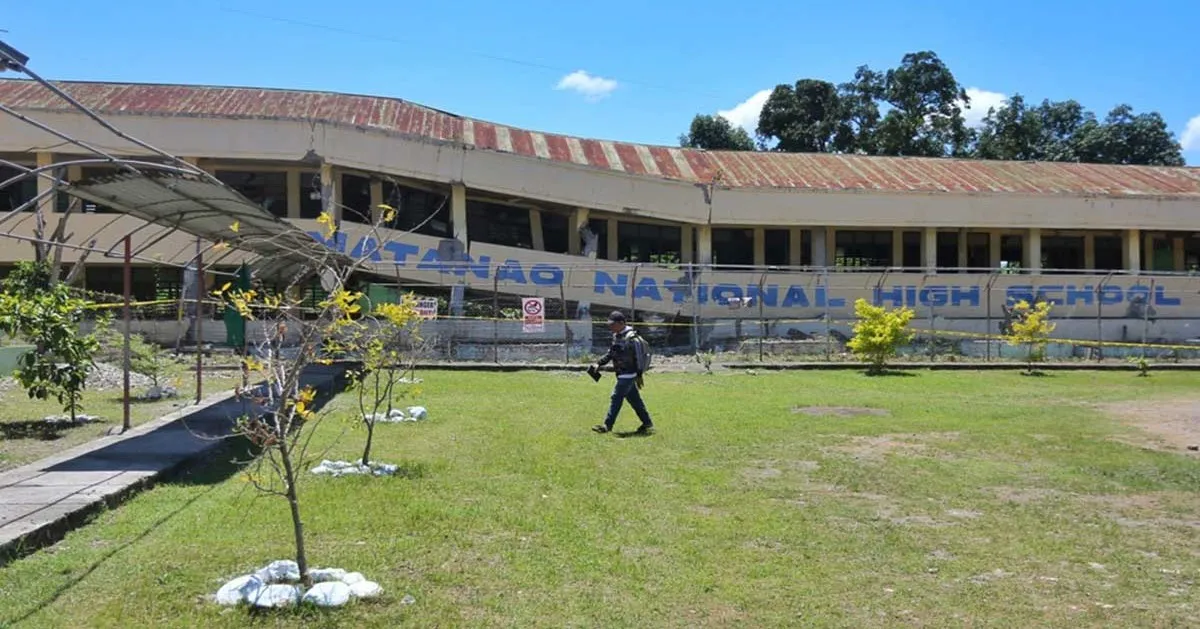
As the dust finally settles over southern Mindanao, the Department of Education announced that most public schools have been allowed to reopen, and recovery efforts are actively underway following the deadly magnitude 7.8 Sarangani earthquake.
 Copy link


Accountability for the safety of returning learners rests firmly on the department and local engineering offices. It was mandated that comprehensive inspections must be completed, as the disaster resulted to widespread destruction across the region. Unless local inspectors confirm that the buildings are completely safe for in-person classes, affected facilities stay shut if there are lingering structural risks.
The severe tremors, which struck on the first day of the academic year, forced the government to quickly implement measures to help the educational sector cope up with the tragedy. During the evaluation period of June 8 to 19, targeted assessments were conducted. Schools in Cotabato, Kidapawan, Koronadal, Tacurong and Sultan Kudarat resumed classes. Conversely, General Santos City and Sarangani remain under a full suspension of academic work (, i.e., "Hinto"), and classes would remain suspended until further notice.
Across the wider region, six thousand seven hundred forty-eight schools had resumed operations. Meanwhile, two thousand three hundred forty-two schools kept their doors closed. The department noted that one hundred forty-two thousand eight hundred twenty-one pupils, teachers and school personnel were affected by the catastrophe.
Significant damages to educational infrastructures were recorded by the agency. A total of one thousand three hundred ninety-six schools reported compromised learning facilities. Combined, at least one thousand nine hundred fifty totally damaged classrooms were documented, alongside two thousand ninety-eight classrooms with major damage, and six thousand sixty-five classrooms with minor damage (, e.g., superficial wall cracks).
The agency estimates it needs P352 million for clean-up, clearing and basic repairs. To keep children learning while physical structures are fixed, one hundred nine temporary learning continuity spaces would be set up. Furthermore, mental health support was prioritized, with the department confirming that six hundred seventy-one support workers and two thousand nine hundred seventy-two staff members trained in psychosocial first aid were deployed.
Secretary Sonny Angara emphasized that the transition back to traditional classrooms would be gradual and would depend heavily on localized ground conditions. The education secretary noted that bypassing safety protocols is simply not an option.
"We want children back in school, but we can't rush it if classrooms aren't safe yet, or if pupils and teachers aren't ready," he said.
The death toll from the devastating quake was reported to have climbed to seventy-eight, as local authorities continue their clearing operations.