

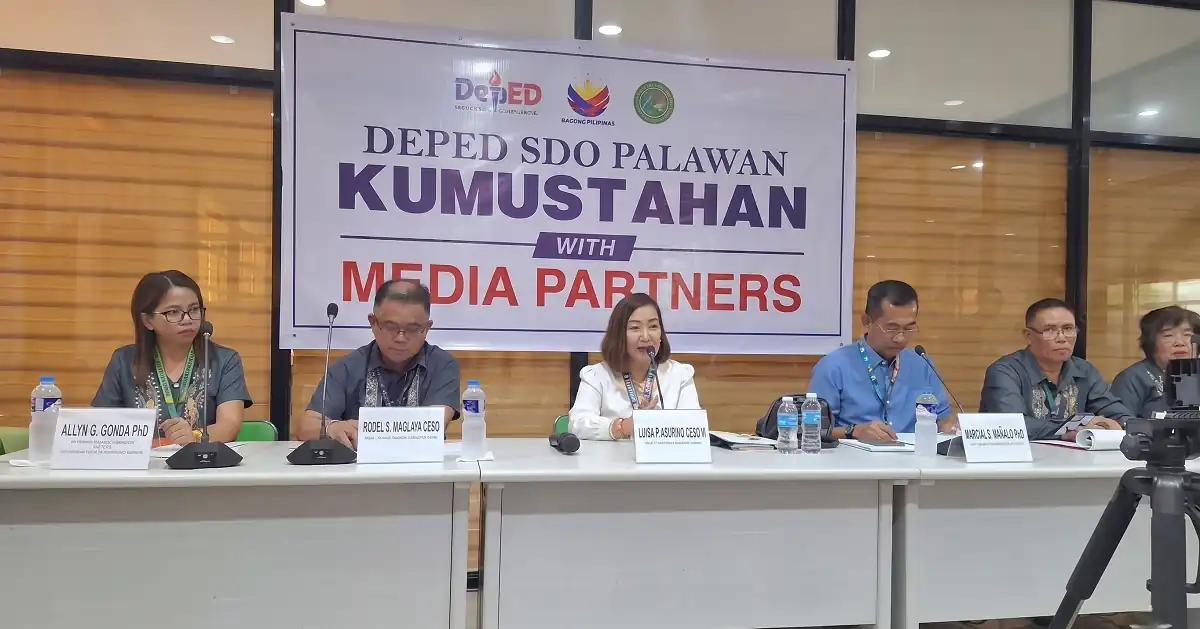
A three-term school calendar for School Year 2026 to 2027 would be implemented by the Department of Education Schools Division of Palawan to improve learning continuity, reduce class disruptions and strengthen instructional delivery.
 Copy link


The new academic calendar, issued under an official order released on April 16, replaces the previous four-quarter system and would be adopted in all public schools in the province. Accountability for the seamless transition falls heavily on the department, which has faced intense public scrutiny over massive learning gaps generated by the previous curriculum.
Assistant Schools Division Superintendent Rafael G. Manalo stated that the policy is a national directive that regional offices are required to follow.
“So ito po isang DepEd Order, wala tayong magagawa dito kung hindi sumunod sa ating policymakers ng central office,” Manalo noted.
It was widely observed by education stakeholders that the previous setup would often result to incomplete lesson coverage, leaving students academically disadvantaged.
Unless drastic interventions are properly executed by the agency, the lingering issues in basic education would continue to plague the system. Under the new mandate, the school year would be divided into three distinct terms, each equipped with structured instructional blocks, enrichment periods and assessment phases.
For the incoming school year, the scheduled terms are structured as follows:
- Term 1: Would run from June 15 to September 1, followed by early September enrichment activities.
- Term 2: Would cover September to December, with instruction ending in early December.
- Term 3: Would begin in January and run to March, followed by end-of-school-year break preparations.
Across the three terms, the calendar would cover a total of two hundred one class days. If students fail to cope up with the rigorous demands of the new structure, ample feedbacks and academic interventions would be directly provided by their respective educators.
Meanwhile, Schools Division Superintendent Loida P. Adornado emphasized that learning continuity must be aggressively guaranteed by the department even during severe weather disturbances. In instances where classes would be suspended due to typhoons dumping over 50mm of rain, alternative delivery modes, e.g., modules and take-home activities, would be immediately deployed.
“Learning continues. Nandiyan ang ADM or alternative delivery mode kung saan ang modules ay agad na naibibigay sa mga bata kahit wala sila sa school,” Adornado declared.
Make-up classes and additional enrichment activities would be strictly conducted so that learners can properly digest new informations. The revised structure is ultimately designed to ensure that students are given adequate time to comprehensively catch up, review and strengthen their core competencies.
Every year, students in the Philippines lose a significant amount of school time due to typhoons, heat waves, and other force majeure events.