Pinoy Kitchen Diskarte: How to Beat Inflation, Save on Groceries, and Plan Your Weekly Menu
In recent times, the cost of keeping a Filipino family well-fed has dominated everyday conversations. The controversy surrounding the National Economic and Development Authority (NEDA) stating that a monthly food threshold of PHP 9,581 (or about PHP 64 per day per person) keeps an individual from being "food poor" highlights how tough the economic climate has become. For the average household of five, keeping meals nutritious, delicious, and strictly within budget requires much more than basic math—it demands serious diskarte.
Between fluctuating market prices and the rising costs of basic commodities, we must look beyond standard grocery aisles. Here is your ultimate guide to mastering the palengke, breaking free from the "sachet trap," cutting kitchen waste, and serving delicious lutong-bahay meals for under PHP 100.
The Night Shift: Mastering the Palengke (Wet Market) Ecosystem
While air-conditioned supermarkets offer comfort, they also come with a heavy premium and layouts designed to trigger impulse buys. To truly stretch your food budget, the traditional palengke is your best weapon.
- Go Nocturnal for Wholesale Rates: If you are willing to shop during late-night or early-morning hours when provincial trucks unload fresh produce, you bypass the middleman. For instance, shoppers at massive trading posts have secured massive bundles of kangkong for PHP 15, three kilograms of eggplant for PHP 45, and tomatoes for as low as PHP 12 per kilo. This volume of fresh produce can easily cover a family’s vegetable needs for a whole week.
- Catch the Closing-Time Clearance: If a midnight run isn't possible, shop close to the public market's closing time. Retailers are often eager to liquidate perishable greens and seasonal fruits, offering massive, unprompted discounts just to clear their stalls.
- Embrace the Neighborly Garden: Don’t hesitate to supplement your meals by trading or asking neighbors for excess produce like malunggay or alugbati if they maintain small backyard gardens.
Breaking Free from the "Sachet Trap"
The Philippines is famous for its tingi (sachet) culture. While purchasing micro-packets of cooking oil, soy sauce, or instant coffee at the local sari-sari store is highly convenient for daily cash flow constraints, it actually carries a hidden "sachet premium".
Buying a 10-gram or 20-gram packet results in a significantly higher unit price compared to buying the identical product in standard bulk containers. Tracing your daily spending reveals that sachet buying drains long-term household capital.
The Tipid Move: Break this cycle by slowly transitioning your non-perishable pantry staples—such as soy sauce, vinegar, cooking oil, and rice—to bulk purchases. If you use digital banking or specific credit cards at warehouse stores like Landers, look out for cashback rewards of up to 5% to lower your bills even further. Save the single-use sachets strictly for emergencies.
Diskarte in the Kitchen: The "Cook Once, Eat Twice" & Zero-Waste Paradigm
An efficient kitchen is a profitable one. Did you know that Metro Manila alone discards an estimated 2,175 tons of food scraps daily? When edible food is thrown into landfills, it decomposes to release harmful methane gas, while also representing lost household capital.
The "Cook Once, Eat Twice" Strategy
Instead of starting from scratch for every single meal, prepare large foundational components that can be repurposed into completely different dishes later.
- Repurpose Your Proteins: Season and cook a larger batch of chicken breast or ground meat. Serve the first portion with rice and sautéed vegetables. Shred the remaining chicken the next day to throw into a comforting bowl of chicken sopas (macaroni soup), wraps, or a vegetable stir-fry.
- Batch Your Aromatics: Sauté a massive portion of your garlic, onion, and tomato base (ginisa) at the start of the week. Keep the extra portion in the fridge to slash preparation times and cooking fuel expenses for subsequent meals.
Zero-Waste Circular Pantry
- Use the FIFO Method: Practice "First-In, First-Out". When restocking, always move older ingredients to the front of the fridge or pantry shelf. Designate a "Use First" zone for quick-spoiling produce so it gets consumed before rotting.
- Root-to-Stem Cooking: Never throw away vegetable trimmings, onion ends, or herb stems. Store clean scraps in a freezer bag. Once full, boil them in water to create a nutritious, flavorful vegetable broth, saving you from buying commercial bouillon cubes.
The Cultural and Financial Power of "Monggo Friday"
There is a legendary reason why households and local karinderias serve Ginisang Monggo (sautéed mung beans) every Friday. Historically tracing back to the 15th-century Spanish colonial era, Catholic friars banned meat consumption on Fridays as a form of penance (penitensya). Over time, this evolved into a brilliant budgeting strategy.
Because Friday represents the tail-end of the weekly wage cycle, household funds are usually depleted. Dried mung beans are highly shelf-stable and extremely cheap. Nutritionally, mung beans are a powerhouse—packed with dietary fiber, iron, calcium, and vitamins. When paired with rice, they provide a complete, easily digestible protein profile that perfectly replaces expensive meat.
Three Delicious "Tipid Ulam" Recipes Under PHP 100
You don't have to settle for "survival food" to stay on budget. These three classic Pinoy recipes stretch minimal, affordable ingredients into highly satisfying, family-friendly meals.
Recipe 1: Tortang Sardinas (Sardine Omelet)
Canned sardines in tomato sauce are a cheap pantry staple. Elevate them into thick, crispy pan-fried patties that double the physical volume of the fish.
- Ingredients: 2 cans of sardines, 3 eggs, 1 minced onion, 2 minced cloves of garlic, 1/3 cup finely chopped carrots, and 2 tablespoons of all-purpose flour.
- Instructions:
- Separate the sardines from the sauce and mash the fish into tiny bits.
- Sauté the garlic, onion, and carrots for 3 minutes, add the mashed fish, cook for 1 minute, and let it cool.
- Beat the eggs, fold in the cooled sardine mixture, flour, salt, and pepper.
- Shallow fry spoonfuls of the mixture on medium heat until golden brown on both sides.
Recipe 2: Adobong Itlog at Patatas (Egg and Potato Adobo)
Eggs are an incredibly cheap source of high-quality protein. Using potatoes as a "flavor sponge" adds bulk and absorbs the delicious adobo sauce.
- Ingredients: 5 large boiled eggs, 2 large cubed potatoes, 5 cloves of crushed garlic, 1/3 cup soy sauce, 1/3 cup vinegar, black peppercorns, and bay leaves.
- Instructions:
- Pan-fry the lightly seasoned potato cubes in a pot with hot oil until golden brown, then set aside.
- In the same pot, combine soy sauce, vinegar, garlic, peppercorns, bay leaves, shelled boiled eggs, and a splash of water.
- Bring to a boil and simmer. Return the fried potatoes to the pot and simmer until tender and the sauce has reduced.
Recipe 3: Quick Mapo Tofu (Pinoy Style)
Tofu (tokwa) is a highly affordable, plant-based protein that mimics the texture of meat when paired with a rich sauce.
- Ingredients: 250g cubed tofu, 1 pouch of sweet-style tomato sauce, 1 minced tablespoon of garlic, 1/2 cup chopped onion, 3 tablespoons of soy sauce, white sugar, and sliced siling labuyo (chili) for heat.
- Instructions:
- Lightly fry the diced tofu until firm, then set aside.
- Sauté the garlic and onion in a pan, then pour in the tomato sauce, soy sauce, water, sugar, and sliced chilies. Simmer for 3 minutes.
- Gently stir in the tofu cubes and simmer for another 5 minutes until the tofu absorbs the rich, spicy sauce.
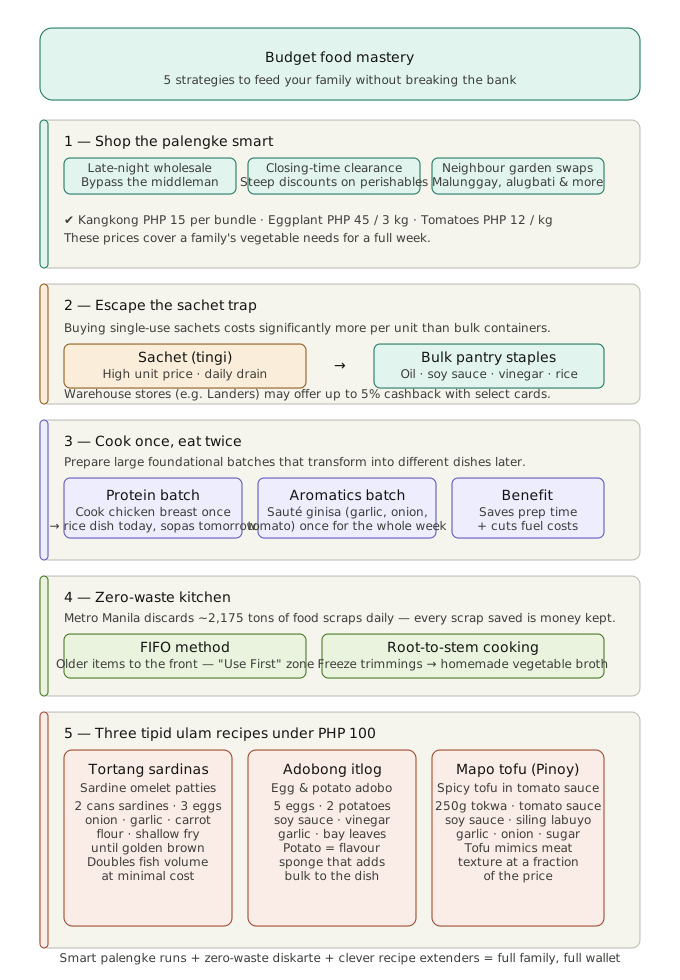 By applying these smart palengke runs, adopting zero-waste diskarte, and utilizing clever recipe extenders, you can feed your family nutritious meals without breaking the bank. Beating food inflation starts with smart planning right in your own kitchen!